
For many startups, social media will be THE number one way to turn strangers into loyal customers.
I mean, what other options DO you have?
Paid ads will cost you a ton of money that you probably don’t have in the beginning stages.
Cold email works – but mainly for services. Can’t really sell blenders over cold email.
But free organic content works for ANY product or service, the barrier to entry is rather low, and it’s, well… free!
Many new founders have precisely zero idea what they’re doing with social media marketing, though. Especially if you’re more of a product guy, it can get quite confusing.
What I don’t want you to do is the following:
Posting memes once in a while, sharing a photo of your office, or reposting a generic quote.

No, no.
You need a STRATEGY, and you need to build relationships with your audience. That’s the name of the game, and I’ll show you the exact steps to take in this article. Social media has been cracked – it’s a repeatable process anyone can learn to master.
Plus, toward the end, I’ll show you a sneaky way I manage to post 30+ times a week in just 2-3 hours per week. Stay tuned 😉
Why Social Media is Non-Negotiable for Startups
Think about the closest relationships in your life.
Did they grow because you saw each other once every three months?
Of course not.
They deepened because of repeated contact, shared experiences, and trust built over time.
The SAME principle applies online. When people see you consistently in their feed, when they watch your videos over lunch, when they read your emails every morning… You stop being just another business account.
You become familiar. And familiarity is the foundation of trust. Every step I show you in this guide will aid you toward that.
The moment your audience faces a problem in your niche, your name is the one they think of first.
They don’t start Googling options; they remember the person who has been helping them, teaching them, and showing up for them every single day.
How To Miserably Fail On Social Media: A Masterclass
This is the last section before I get into exactly what you should do, I promise.
First, you have to know that…
One of the fastest ways to fail on social media is to treat it like a one-way transaction.
Think of it like meeting someone new. At first, you’re a casual acquaintance. Then, with more interactions, you become familiar. Over time, you feel like friends. Eventually, you’re someone they trust deeply. That’s the same progression your followers go through online.
To move people through those stages, consistency is key. If you post once every few weeks, they’ll forget you exist. But if you’re in their feed daily, they’ll start recognizing your name and your face.
Soon enough, you’ll feel like part of their routine, and they’ll start interacting with you (sending emails, commenting, buying your stuff).
That’s how you know you’re building relationships.
Content That Converts: Always Focus On Authority
Let me finally give you some good news:
You do NOT need fancy edits and graphics to grow a following of action-taking customers on social media.
All that matters is… authority.
Memes, funny quotes, or lifestyle shots may get likes – but not authority. Authority is what makes people buy.
Authority content does three things at once: it educates, entertains, and sells. The format doesn’t matter as much as the substance. If people leave your post having learned something useful, felt a spark of connection, and seen you as a trusted guide, you’ve done your job.
I repeat, none of this needs to be fancy. The BEST performing videos (in terms of authority) are literally…
Talking Head Videos

Talking head videos are one of the easiest ways to build that authority.
They’re simple: you, your phone, and your ideas.
They feel raw and authentic, like you’re FaceTiming a friend, and the algorithm tends to reward them because viewers stick around.
Here’s a checklist to make them work:
- Hook hard in the first 3 seconds. If your audience isn’t pulled in immediately, they’ll scroll away.
- Script in advance. Recording line by line saves time and keeps your message sharp.
- Re-hooks. Drop mini-hooks every 10–15 seconds to keep viewers engaged.
- Delivery practice. Speak clearly, with energy. Awkward delivery will sink even a great idea.
- Captions and edits. Add captions, trim pauses, and keep the pace fast.
- Long captions. The longer your captions are, the longer people will read – thus increasing watch time.
*A note on watch time: Watch time (or retention rate) is the number ONE metric that defines how many people will see your content. If you see a big drop in the first 3 seconds, it means you’re not hooking people that well. The longer the retention rate, the more views you’ll get. It’s simply how the algorithm works.
Once you get into the rhythm of creating talking head videos, you’ll be surprised by how effective they are at building a following that actually listens (and buys!)
Create a Free Resource That Builds Trust

Okay, you’re creating authority content. That’s great ‘cause you’re getting attention.
But attention alone doesn’t pay the bills. You need a way to capture it.
That’s where a free resource (aka a lead magnet) comes in.
A lead magnet is something valuable you give away in exchange for someone’s email address. It can be an ebook, a checklist, a mini-training, or even a template.
The format matters less than the perceived value.
The key is to make it so valuable that it almost feels wrong to give it away. If you’re creating it and you find yourself thinking, “I could charge money for this,” you’re on the right track.
That’s what builds trust and the WOW factor. You have to WOW people with every single product you have, even if it’s free.
When you create it, I want you to promote it in your content. Every. Single. Day.
“But… how in the world do I collect these emails, and where do I give away the lead magnet?”
Glad you asked!
How To Build an Email List with ManyChat
Have you ever seen those captions and CTA that go something like:
“Comment SALES and I’ll send you my full sales guide for free.”
And then, like a horde of zombies, the comments say:
“SALES. SALES. SALES. SALES… and you see 476 comments on a single post.”
That’s what I want you to do as well.
The tool is called Manychat. Here’s how it works:
- Someone comments the ‘trigger word’ on your post.
- You automatically send them a message asking for their email address.
- They reply with their email address.
- Manychat automatically adds them to your email list and sends them a welcome email with the lead magnet.
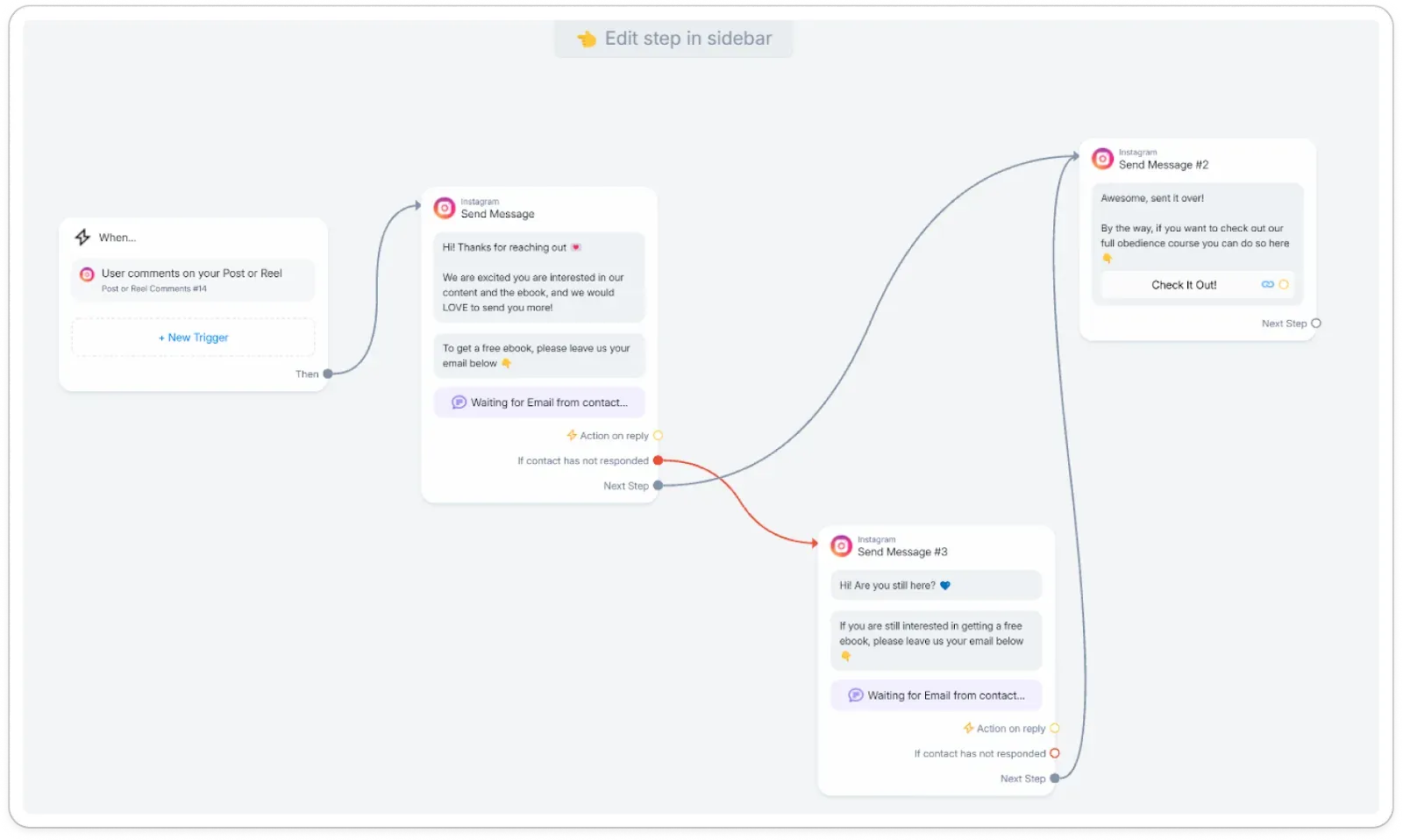
Quick recap…
You post valuable content, build curiosity by hinting at your free resource, and then give a clear call to action: comment a word to receive it.
When someone does, ManyChat captures their email and sends them straight to your landing page.
It’s simple, but powerful. It boosts your engagement (because comments signal the algorithm), grows your list, and starts funneling people into your sales process automatically.
This article is NOT just about content and social media videos. I don’t want you to think about social media as an isolated medium.
It’s part of the sales process. Part of the sales funnel. That’s why I’m including these sales explanations as well.
Time for another one…
Craft a Sales Page That Actually Sells
Once someone trusts you enough to download your resource, the next step is to show them your offer. This is where your sales page comes in.

A sales page isn’t just a product description. Think of it like this when you’re creating it:
What does my customer currently believe, and what do they need to believe to buy the product?
Here’s a 10-step blueprint for a strong sales page:
- Catchy headline with big promise
- Write a hook that’s actually engaging – people need to be hooked to read everything.
- Address their pain points and dream scenarios.
- Use multiple sensational sub-headlines.
- Make juicy bullet points and expand on one with a different angle so the reader doesn’t start skimming.
- Price anchor (don’t be too cringy with it though, e.g., “In the right hands, this info could be worth $99999, but I’m selling it for $39!”).
- Use bonuses and feature the best one first and foremost.
- Use humor throughout the page to induce ‘ADHD hits’ and to disarm sales guards.
- Use testimonials after making a claim, and put your replies to make it seem more human and real.
- Think of all the objections the customer could have as they read the page, and overcome them.
Now, you know multiple things – not JUST about social media – but all relating to social media:
Firstly, you learned how to get attention and create quality content. Then, I taught you how to funnel that attention to your email list. And lastly, you’ve learned how to sell on your landing/sales page.
It would make no sense to write about social media without these other things, as they’re ALL part of one integrated sales process.
How I Post 30+ Pieces Of Content Across Socials Every Week Without Burning Out – Or Almost Without Even Lifting a Finger!

Posting once a day, every day, across multiple platforms sounds exhausting. And it absolutely can be.
That’s why people have a team and various software working for them.
(I am people.)
Here’s my setup:
I use AI to automate a good chunk of my content creation.
I won’t get into how it all works exactly, as I’m working on a DFY product relating to that, but in short – Airtable, n2n, and Make are connected, and they automatically make my social media posts.
They simply take parts of my blogs and adapt them for the specific social media platform (Instagram carousels, threads, X, Facebook…)
My content strategist selects the blogs, feeds them to the AI, and curates the output.
In 2-3 (sometimes a bit more) hours per week, he creates 30+ pieces of content every week.
Of course, the AI cannot make amazing things, so you still need to have:
- Good knowledge of social media and hooks – so you can EDIT the AI output.
- A lot of other high-quality content that you manually create yourself (e.g., talking head videos).
The secret is to repurpose and automate. Instead of trying to create 30 completely new posts every week, you start with one bigger piece of content — a blog, a YouTube video, or even a long email.
From that, you slice it into multiple smaller posts. Each section becomes a tweet, a reel, a carousel, or a LinkedIn post.
Batching also helps. Film a week’s worth of talking head videos in one sitting. Change your shirt a couple of times for variety. Suddenly, you’ve got seven days of content done in an hour.
Wooohoo!
When you start getting some traction, some people will inevitably dislike it. Enter the next section…
Handling Trolls and Criticism
If you put yourself out there, you’ll attract trolls. That’s a GOOD thing.
I’d go as far as to say that actually – if you’re not getting hate comments – you’re not doing something right.
When you have strong opinions and truly put yourself out there, some people will obviously dislike it.
You need to have people who hate you if you want to have people who sing your praises.
The key is not to take them personally.
Don’t waste time responding privately or getting dragged into emotional battles.
Instead, use the troll to make MONEY.
Make fun of them in your email list / social media and use them as entertainment for your fans (and as a display of what happens when people don’t act right).
Then… make a sales pitch, and profit from the trolls. They’re an amazing source of sales, when done right.
Takeaways
Social media is the #1 way to turn strangers into paying customers in the beginning stages of a startup. But it only works if you treat it like a system, not a hobby. Here’s what to remember:
- Relationships online work just like real life — the more touchpoints, the stronger the bond. Show up consistently.
- The fastest way to fail is to randomly post BS. You should focus on building trust, not just posting content.
- Authority > likes. Talking head videos are one of the simplest and most effective formats to create authority that sells.
- Always funnel attention somewhere you control. A free resource + email capture system (like ManyChat) turns followers into leads.
- Your sales page should transform beliefs, not just describe features. Use storytelling, objections, and bonuses to guide readers to “yes.”
- Repurposing is the secret weapon. Start with one big piece of content, then slice it into 30+ posts per week using batching + automation.
- Trolls = sales fuel. Use criticism as entertainment and pivot it into offers.