

A man gets a letter.
He moved abroad for the first time a year ago. Now the letter says he owes money. The insurer kept charging contributions by mistake after he left, and a debt piled up. He searches for help in his own words: debt, the letter, "I left".
He finds a firm that solves exactly this. Its menu says "Tax residency and ending tax residency".
He never used those words. So he closes the tab.
(He's a composite of what many people in this situation say in public. The closed tab is very real.)
Why would a firm hide the exact pain it solves behind a term its buyers never say?
By the end of this article you'll have a before/after menu you can copy, and a twenty-minute check that shows whether your site does the same thing to your buyers.
A pharmacy sorted by chemistry
Another exaggerated example. Walk into a pharmacy with a migraine. The shelves are sorted by compound: acetylsalicylic acid, ibuprofen, sumatriptan. Everything is correct. Nothing is labelled "headache".
You stand there, in pain, reading chemistry.
It sounds absurd. Yet most service websites work exactly like that pharmacy. On a service website, the menu lists what the seller does – tools, deliverables, service names. Strategy. Implementation. Audits. Annual reports. None of these names is wrong. That's what makes the problem slippery. (Same mistake in offers: selling deliverables instead of outcomes.)
To buy, the visitor has to learn your profession, diagnose himself and pick the right tool. You've handed these jobs to the person who knows the least. And the most anxious one, too.
Strange way to begin a relationship.
Why the firm couldn't see it
Back to the firm. It wasn't hiding anything. It couldn't see it.
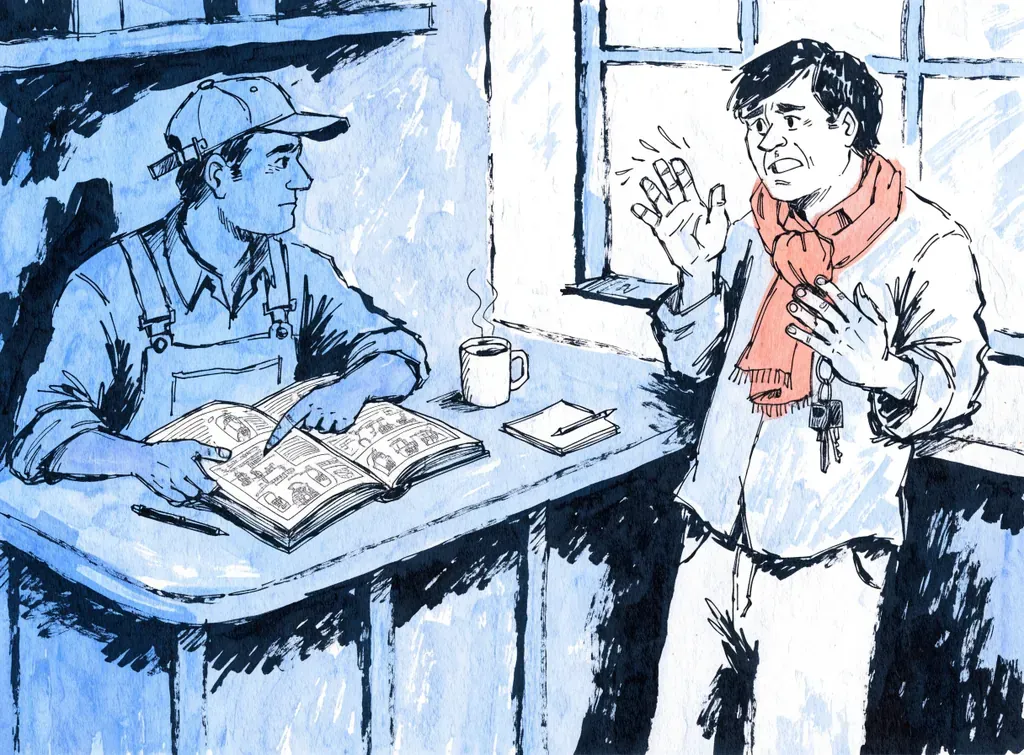
Experts name their work by how it works, because they built it. Buyers care about their situation the most. A mechanic knows the technical name for the repair. The driver says the car is making a weird noise. (My own version of that sentence was much ruder.) Both are reasonable. They're standing on different sides of the counter.
Funny thing is, I taught this badly myself. In my own website course (I had it in 2025) I described two ways to arrange your offers. By need – the Home Depot approach: plumbing aisle, lighting, paint. For a consulting firm that meant "Strategy, Implementation, Training". And by persona – "For startups, For corporates, For small business". I said the same thing on LinkedIn in March 2025.
Both ways still work – one level down, once the visitor is inside.
What my work this year showed me is a third way. It starts with a different question: what just happened in this person's business, or life, that made them look for help today? That's the buyer's situation, in the buyer's words. It's the front door. The aisles and the personas come after it. (Marketing textbooks call this moment need recognition – the first step of the buyer decision process.)
The good news: the offer usually fits already. The firm from the first story does this job. It simply wears the company's clothes. You don't need a new offer. You need a translation. And translation is the cheaper fix.
Honest limit: a better menu removes a barrier. It doesn't create demand out of nothing. If nobody wants what you sell, clear labels will only help them find that out faster. (Not sure which one you have – a words problem or a demand problem? I wrote a short page around the one question that tells them apart.)
What the translation looks like
An accounting company I worked with thinks in categories like these – and its website was built the same way:
- Business registration
- Tax residency
- Audits
- Annual reports
The situations its buyers actually arrive with look like this:
- I opened my first business
- I moved abroad, and someone says I owe money
- I got a frightening letter
- I sold property in another country
Same firm. Same services. The professional names stay – one level down. Someone clicks "I moved abroad, and someone says I owe money", and only then learns that the relevant service is called tax residency.
The expertise stays deep. The front door becomes recognisable.
Software works the same way. At Creative Engines, my other company, I once walked our team through the new interface on an internal call. The engine had collected a few hundred pieces of evidence about a market – real publications, each with a link. We called them "Evidence". A dull little word for one of the best parts of the product.
One colleague, from our sales side, was seeing the interface for the first time. The comment: "The way you express it, that's your vocabulary. People don't think like that."
Then she said what the product does in a buyer's words: it's research – "I don't have to read through all of this, I immediately get a summary". That alone was clearer than our labels. And she was the one who had to sell it: without proper onboarding to the new interface, she said, there was no way to explain it to a prospect.
No new feature. No product discovery. Just a pair of eyes our own vocabulary hadn't trained yet. (An outsider is the cheapest mirror you'll ever get.)
And this blog? Its sections are still topics: Marketing, Strategy, Build. I'm moving them to a plain name plus the reader's situation – the first one is "Positioning – They want it. They don't get it."
Your private words are charging rent
I learned this one the expensive way.
At Creative Engines we used one classic advertising term freely, everywhere. In our own familiarity test across 22 buyer types, it scored 1.56 out of 5. In 44 of 66 reads it landed at zero or one. The bill for our private vocabulary was a website rebuild.
A word we thought was normal had become a small toll booth in front of the product.
And people aren't the only readers of your menu any more.
We once let an AI read an accountant's website to capture his business. It found five services, all bookkeeping. His second business – foreign income, double taxation, residency, stock options – had its own pages and its own menu section. None of it reached the record. The menu had buried it, so the machine buried it too.
Search engines and the AI assistants your buyers ask for recommendations read the same half. They don't politely fill in the gaps. (Neither do people. People just leave faster.)
Your buyers already said the words
You don't have to invent the new words in a brainstorm. Your buyers already said them.
Before we rewrote the four main pages of the Creative Engines site, we went through 28 recorded market calls plus field notes. The calls told us which phrases made people switch off. "Content factory" was dead – one partner called it "too tired a phrase to use". Follower-and-reach language was poison: a founder who had grown 15,000 followers with almost no revenue named exactly that as the thing that burned him. And a financially literate adviser visibly woke up the moment the talk turned to what marketing spend does to EBITDA.
The richest calls were the ones where people said no. They explained why. (Same with a unique selling proposition: the strongest ones are heard, not written.)
Sometimes the word is even closer. When we asked simulated buyer portraits to describe my consulting to a friend, one word kept coming back: operator. It was already in the name of my flagship offer. It had been sitting on my own price list for months, like a guest in the room who never took off his coat.
(Classic founder behaviour. I recognise the species.)
And if your product is so new that buyers have no word for its category – they still have a word for their situation. Start there.
Sometimes the buyers beat me, too
Once another founder, my client, overruled my advice.
I came to the website copy review session armed with the rules. His website hero was failing the five-second test. Invented navigation labels cost attention. We need to simplify! We need to use recognisable patterns in the menu items.
He came armed with what his buyers told him on calls: anything that smells of marketing gets handed to a subordinate, and anything that smells of a startup gets handed to the engineers. So he kept his deliberately formal, Big-Four register, on his website. And I agreed.
He may well have been right. His buyers knew things my rules didn't.
That's the whole point. The rule isn't "use my words". The rule is "use your buyers' words". Mine included. (Annoying. Healthy.)
The twenty-minute check
You can run it tonight.
- Write down three situations your buyers are in when they come to you – in their words, not yours. "I got a frightening letter" beats "tax-residency support".
- Search your site for those words. If you find service names and module labels instead, you've found the problem.
- Rewrite your menu situations-first. Keep the professional names one level down. You change the labels, not the page addresses – so your search rankings stay where they are. Then do the same on the pages behind it (a practical guide to website content).
- Ask two or three AI assistants what your company does, using only your homepage – Claude, Gemini, whichever you like. Try: "Based only on this page, what problems does this business solve, and for whom?" Compare their answer with what you meant. (Use a clean AI with no memory of you or what you're doing – or ask it to run a clean sub-agent.)
Don't ask whether your menu sounds sophisticated. Ask whether a worried, busy person with proper context in his head can recognise his own situation in it before he understands your profession.
If it stings, good. It's the cheaper problem.
Don't make your customer diagnose himself.
Let me label my own shelf
This is the part of every consultant's article where he sells you something. So let me at least label my shelf the way this article told you to – by your situation, not my profession.
Shelf one: "I checked my menu and winced." Inside: The First Read – one focused half-day of my attention, the sharpest finding, the obvious breakages and your next move, in writing within one or two business days.
Shelf two: "I checked, and it's fine." Inside: nothing. Close the tab. You're good.